


Even These Things
- Oliver Phillippo
- May 22
- 4 min read

Manchester Royal Exchange Review
⭐⭐⭐⭐

‘Do you think the city’s forgotten?’
Three centuries. Three moments in time. An epic story of Manchester and Ireland by multi award-winning playwright Rory Mullarkey premieres at the Royal Exchange Theatre, 30 years after an IRA bomb devastated the heart of the city.
In 1846, Annie Donovan has a score to settle; in 1996, it looks like any other Saturday morning in Manchester; and in 2026, Jenny moves back to the place where she grew up.
This original and moving new play explores private and public histories, grief and love – and the making and re-making of our city.
‘Even These Things’ is a brand new piece of writing by acclaimed playwright Rory Mullarkey which is being debuted as part of the Royal Exchange Theatre’s 50th anniversary season and is essentially a celebration of Manchester, its history and its people.

The play follows a unique structure in that it doesn’t really have a plot but instead thematically ties together three short stories from different points across the history of Manchester. These include a violent conflict between two Irish immigrants in 1846 over the murder of a pig, the events of the morning of the IRA bomb in 1996 and an awkward conversation between two strangers in a park bench in 2026.
Through these sequences, the play addresses what it means to be ‘from Manchester’ but also more broadly raising conversations about how we are formed by where we live and how our histories relate to us living in the present. There is also a heavy focus on the idea of being Irish in Manchester, tying in with contemporary discussions about immigration which makes sense given the fact that Mullarkey is of Irish descent himself but also because of the shared history which is highlighted throughout the play.
We start off with what I found to be the strongest part of the play, an extended one-woman monologue which tells the story of an Irish immigrant, Annie Donovan, who gets into a fight with a woman who killed her beloved pig. What starts off as a seemingly silly concept becomes a surprisingly emotional piece and it’s truly a feat of theatre that through the incredible writing of this sequence and the stunning performance by Elaine Cassidy, who performs the entire thing for around 45 minutes with no set or props manages to convey such a gripping story which succeeds in keeping the audience on the edge of their seat.
I don’t want to give too much away but honestly I would have been happy if this had been the entire play but after a truly nailbiting fight scene and a heartwrenching closing to this act the play moves swiftly on to 1996.

The next section was a complete contrast to the first in every conceivable way. Going from a one-woman performance with no set, we then find ourselves with an astonishing number of sets and performers which really did take me by surprise.
Rather than being a ‘story’ as such, we see a plethory of characters entering and exciting the scene in a fast rotation, each of which representing traits which would be instantly recognisable to anyone who has spent any time in Manchester (or any major city to that matter). It’s a fantastic piece of observational writing which truly gives the sense of peoplewatching in a town centre with some very funny sequences.
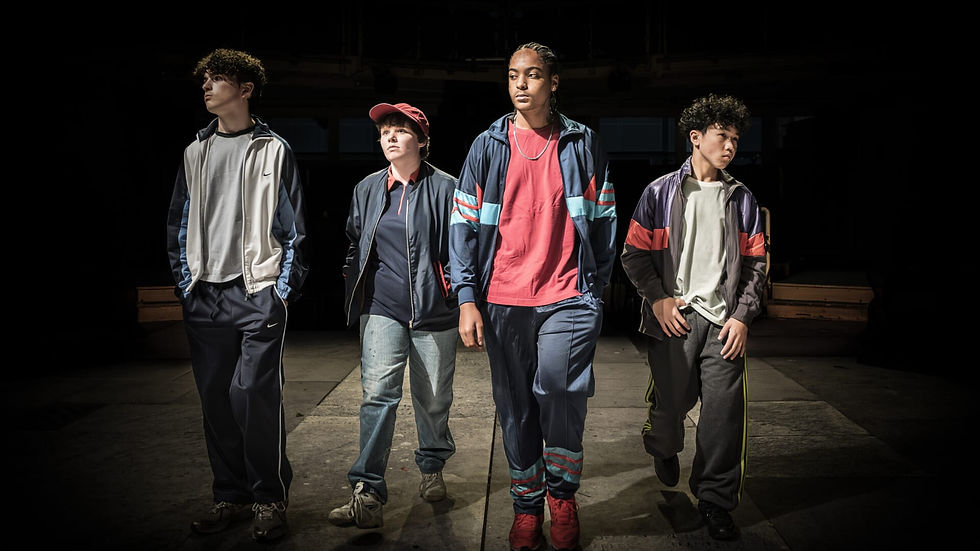
Throughout all of this was the subtle feeling of dread as the people we are watching gradually become aware of an 'ongoing incident' in the heart of the city and the realisation sinks in for the audience of what is about to happen.
However, I do think that it was in this section that the play started to slightly buckle under its own weight. While I understand that these creative decisions were intentional and independently of each other very effective, we spent so long just introducing so many characters without much really happening that it started to lose focus and as a result, my attention.
We ended with what was the most traditional piece of theatre writing of the whole play, an extended conversation between two women who live in Manchester as they discuss their relationship to the city and its history. I found this to be the the weakest of the three sections, not because it was badly written but more because it exposed some of the floors with the unusual structure of the play. It tries very hard to get an emotional response from the audience but because we have been jumping around so much and exploring so many different ideas, we haven't spent enough time with these characters for the emotional beats to hold any weight.

The play is occasionally a little frustrating in this regard because individually there are some such wonderful ideas being shown and the writing is consistently brilliant but there is so much going that it lessens the impact of all of them and I can't help feeling that with a narrower focus, 'Even These Things' could have been considerably more impactful.
Despite some of its structural floors, I was still very impressed by the quality of the writing and I would love to see a copy of the playscript because there were so many clever lines which I can’t remember all of but were very effective in getting across the messages of the play.
Overall, ‘Even These Things’ is a cleverly written experimental piece of theatre with powerful performances which raises many fascinating discussions and while the impact of the piece may be slightly limited by its structure, it will certainly leave you with lots to think about.
‘Even These Things’ is running at the Royal Exchange Theatre in Manchester until 15 June with tickets available from £12.
Comments